Christ Is Our Atonement

This week the Jews are celebrating Yom Kippur. In English this feast is called the Day of Atonement. The truth is that the Jewish feasts, like everything else described in Scripture, point to Jesus Christ, to His glory and to His finished work on the cross.
For many people Christ’s sacrifice on the cross comes down to this: “Jesus died on the cross for people’s sins, but if I sin, I need to confess.” In fact, in what our wonderful Lord, who loves us, accomplished for us on the cross there are hidden so many wonderful truths, and as we come to know them, we can be set free from religious dogmas. Paul writes to the Corinthians: “But of Him you are in Christ Jesus, who became for us wisdom from God; and righteousness and sanctification and redemption” (1 Cor.1:30) Christ is not only our wisdom, our righteousness and our holiness, but He is also our redemption, our atonement. So today I pray that what the Lord has revealed to me will be revealed to you too, and that you will see the glory of Christ and the power of His finished work on the cross.
There is an interesting and instructive Bible principle: when a word appears in the Bible for the first time, a precious truth revealing Christ is hidden there. Why is that? Because Jesus Himself said: “I am the Alpha and the Omega.” Alpha is the first letter of the Greek alphabet, and Omega the last. And Jesus is the Word of God, so when a word appears for the first or the last time, a revelation of Him is hidden there.
In Hebrew — the language in which the Old Testament was written — the word for atonement is kippur, as I think you have already guessed from the name of the feast, and this word first appears in the following verse of the book of Genesis:
Make yourself an ark of gopherwood; make rooms in the ark, and cover it inside and outside with pitch.
–Genesis 6:14
Someone may say: “And where in this verse is the word atonement?” In fact, my friend, this word appears in this verse as many as two times, which tells us that a double portion of God’s blessing and revelation of Christ is hidden here. The word cover (with pitch) in Hebrew is kaphar (H3722), meaning to cover (with pitch), to appease, to reconcile, to cleanse, to make atonement, to be atoned for. What a rich Hebrew word. And the word pitch is kopher (H3724), and is translated as pitch, ransom, atonement. Although these two words sound different, they are written the same way. The first of them is a verb and is the root, and the second is a noun. (Hebrew is read from right to left)
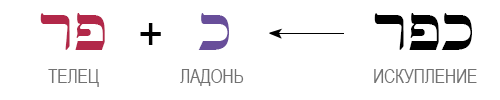
Hebrew is interesting in that you can see Christ even in every letter. The letter Kaph means the palm of the hand and even looks like a bent human palm. The palm symbolises the hands of the high priest, with which he blessed the people and which he also laid on the animals before they were offered as sacrifices to God. The next two letters, Pe and Resh, form the Hebrew word par (H6499), which is translated as a sacrificial bull. So the word atonement is the hand of the high priest who offered a bull as a sacrifice.
Atonement Inside and Outside
When Israel walked through the wilderness, Aaron was their high priest, and every year on the Day of Atonement he entered the Holy of Holies with the blood of the bulls and goats that were offered as sacrifices for sins. The Lord said to Moses: “Aaron shall offer the bull as a sin offering, which is for himself, and make atonement for himself and for his house.” (Lev.16:6) Here make atonement is our very word kaphar, which in Genesis is translated as cover with pitch. Aaron here is a type of our Lord Jesus Christ, while in the story of Noah the type of Christ is the ark, through which Noah and his family were saved. You may ask: “If Aaron symbolises Christ, why did Jesus need to be cleansed, since He was not sinful?” Yes, Jesus is a sinless and righteous Man — more precisely, He is the very righteousness of God — but on the cross He became sin. Being our representative, He took our place on the cross and in His body cleansed us, or atoned for us.
Then why did the Lord tell Noah to cover the ark with pitch inside and outside? It is interesting that on the Day of Atonement Aaron also took the blood of the bull and sprinkled it on the altar, which was outside the tent, and also on the mercy seat, the cover of atonement, which was inside the tent, in the Holy of Holies. The altar is a type of the cross of Christ, where the Lord was sacrificed and shed His blood, and the mercy seat, the cover of atonement, is Christ Himself.
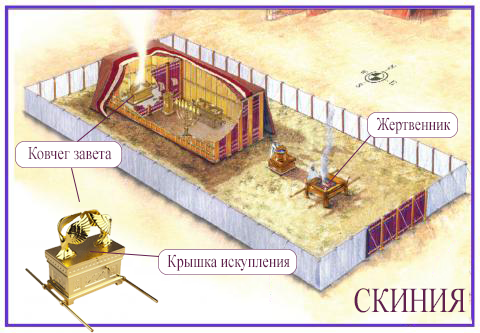
In the letter to the Hebrews it is written: “But Christ came as High Priest of the good things to come, with the greater and more perfect tabernacle not made with hands, that is, not of this creation. Not with the blood of goats and calves, but with His own blood He entered the Most Holy Place once for all, having obtained eternal redemption.” (Heb.9:11-12) And in the following verses the author of the letter explains why Christ did this: “For if the blood of bulls and goats and the ashes of a heifer, sprinkling the unclean, sanctifies for the purifying of the flesh, how much more shall the blood of Christ, who through the eternal Spirit offered Himself without spot to God, cleanse your conscience from dead works to serve the living God?” (Heb.9:13-14) The inner atonement, or the pitch inside in the case of Noah, is needed precisely to cleanse, or atone for, our conscience.
Many people think that the Lord condemns people for their sins and mistakes, but the truth is that Jesus, our High Priest, sprinkled His blood on the mercy seat, and the cherubim, which symbolise God’s eyes, now see only the perfect blood of the Lamb of God. The Lord sees those who are in Christ, who, like Noah in the ark, are perfect. The Lord God has given us a good conscience, which does not condemn. The Lord Himself said, and the Holy Spirit has testified: “Their sins and their lawless deeds I will remember no more.” (Heb.8:12; Heb.10:17) And if the Lord does not remember our sins, our conscience does not remember them either; but if condemnation is gnawing at you, it is not from the Lord, but from the enemy, who walks about like a roaring lion, trying to devour those who accept condemnation as coming from God.
The outer atonement, as you have already learned, took place at the bronze altar, which symbolises the cross of Christ, and it is atonement from the condemnation in which this world lies. Noah’s ark floated on the waters of the flood, which are a type of the condemnation and judgment on this world, but Noah and his family were completely safe. Just as the Israelites were safe when they put the blood of the lamb on the doorposts of their houses. When the destroyer went through Egypt, he passed over their houses and did not touch them. So today too, Christ shed His precious blood on the cross and redeemed us from any condemnation or harm that the wicked one could do to us. If you hear people say that if you sin and disobey God, He will withdraw His hand of protection and the devil will be able to torment and terrorise you, then remember Noah and his family, who were in the ark. What could Noah possibly do for the waters of the flood to do him any harm? The ark was covered with pitch (atoned for) on the outside, and the waters of the flood had no effect on it. Remember the blood Christ shed on the cross. God cannot withdraw His hand of protection under any circumstances, because He would have to wipe away the blood Christ shed!
That is why Jesus said: “He who believes in Him is not condemned; but he who does not believe is condemned already, because he has not believed in the name of the only begotten Son of God.” (Jhn.3:18) A believer is one who is in the ark, who is in Christ Jesus, so he is not judged by the waters of the flood, and there is no condemnation for him. He is, as David wrote, the one “who dwells in the secret place of the Most High” and who “Shall abide under the shadow of the Almighty…” (Ps.91:1) and further: “A thousand may fall at your side, And ten thousand at your right hand; But it shall not come near you.” (Ps.91:7)
The Price of the Sacrifice
Even in the Old Testament, when bulls and goats were offered as sacrifices, the sacrifice was enough to cover Israel’s sins for a year. For a whole year a Jew could live without consciousness of sins, knowing that on the Day of Atonement a sacrifice had been offered and blood had been shed for him. But today we see people taught that the blood of Christ is not enough even for one week, and in some cases not even for a day, because they demand daily confession. “If you haven’t confessed your sins, you’re not forgiven.” It is as if the blood of Christ is lowered to a level below the blood of bulls and goats. This misunderstanding arises because many people simply do not know the worth of the One who shed this blood for them, and not knowing the price of the sacrifice, they accordingly do not value or understand the power of this atoning sacrifice of Jesus Christ.
Noah’s ark can also lift the veil a little for us, so that we can see who this Man is who gave His life for us on the cross. The Lord said to Noah: “Make yourself an ark of gopherwood…” (Gen.6:14) In Scripture a tree symbolises a man, and this points to the fact that Jesus was not only the Son of God, but also a Man. And the word gopher tells us what kind of tree this is, or what kind of Man.
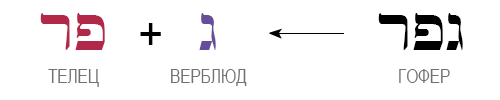
Notice that, as in the word kaphar (atonement), this word also contains the letters Pe and Resh, forming the Hebrew word par. It is translated as a sacrificial bull, but unlike the word atonement, which begins with the letter Kaph, the word gopher begins with the letter Gimel. Every letter of the Hebrew alphabet symbolises some object, animal or idea. In this case the letter Gimel symbolises a camel. You may think: “And what does a camel have to do with anything?” But you know, the Lord created animals so that man could also see God’s glory in them and come to know Him, and a camel too can tell us about the Lord and His love.
In Bible times camels were the most valuable animals their owners had. Out of all the many cattle with which the Lord had blessed Abraham, the servant took camels to choose a bride for Isaac, and when people went to seek a bride, they took the very best there was in the house. (Gen.24:10)
Also, the root of the Hebrew word for camel (Heb. gamal; H1581) is the verb gamal (H1580), which means to complete, to ripen, or to wean. It is the last meaning that I want to draw your attention to. In the Gospel of John it is written about Jesus: “No one has seen God at any time. The only begotten Son, who is in the bosom (breast, heart) of the Father, He has declared Him.” (Jhn.1:18; my addition in brackets) Jesus, being the Son of God, always existed in the bosom, or at the breast, of the Father, in the place of God’s love, but when the fullness of the time had come, as Paul writes to the Galatians, God sent forth His Son. (Gal.4:4) In other words, at the moment of His birth the Son was weaned from the Father’s breast.
We always keep what is most precious in our life closest to our heart, to the place of our love. Jesus said: “For where your treasure is, there your heart will be also.” (Mat.6:21) The most precious thing in the whole universe that the heavenly Father had, God’s treasure, which was always in His bosom, in His heart, is His beloved Son Jesus Christ. And He gave this treasure for our sake! The apostle John writes: “In this the love of God was manifested toward us, that God has sent His only begotten Son into the world, that we might live through Him.” (1 Jhn.4:9)
My friends, it was not the blood of bulls or goats that was shed for you and me. God did not spare what was most precious, so that with Him He would also give us all things. Such is His love for us. That is why it is so important to know the Man who gave His life for us. As we come to know Him, we come to know the price of His great sacrifice, we come to know the price of His blood, and then we will always abide in peace and rest, knowing that if God did not spare His most precious and beloved heavenly treasure for our sake, how shall He not with Him also freely give us everything else? How can He hold anything back from us, if He gave what was most precious, and did it while we were still sinners? God no longer needs any of our sacrifices, because the sacrifice of His Son has satisfied Him completely.
Now our heavenly Daddy simply wants us to enjoy His love through the love of our bridegroom, Jesus Christ. He has placed us in the place of His love, in Christ Jesus. In the place where there is no condemnation, where nothing stops Christ from loving us. As beloved Paul wrote: “nor any other created thing, shall be able to separate us from the love of God which is in Christ Jesus our Lord!” (Rom.8:39)
Leave a Comment
Comments
| 🙂 | 🙁 | 😄 | 😎 | 😉 | 😮 | 😢 |
| 😰 | 😐 | 😘 | 🤭 | 😛 | 😝 | 😳 |
| 🥴 | 😴 | 😲 | 🥱 | 😍 | 🥰 | 💗 |
| 😟 | 😠 | 🤓 | 🤐 | 😷 | 🤔 | 😇 |
| 👍 | 👎 | 💪 | 👏 | 🌞 | ⛪ | 🙏 |
| ⏱ | 🎵 | 🎧 | 🌻 | ⭐ | 🍰 | 🥳 |
Называть Всевышнего, Творца всего мироздания мирским словом “папочка” значит проявлять неуважение, духовное невежество. Отсутствие благоговения и страха Божьего…
Апостол Павел писал,что мы не получили духа рабства, чтобы опять жить в страхе и называть Бога Творцом, но Духа усыновления, которым взываем “Авва! Отче!” Дух Святой не зря оставил имя Отца на иврите не переведенным, потому что Авва на иврите дословно будет папа. Молюсь, чтобы вы также приняли Духа усыновления и познали любовь нашего Небесного Папочки. 🙂
Аминь! Как сладостно, что Он именно Папочка ❤❤❤
СЛЁЗЫ САМИ ЛЬЮТСЯ!!! КАКОЙ ПРЕКРАСНЫЙ НАШ ГОСПОДЬ!!! А ЕГО ЛЮБОВЬ К НАМ??? СПАСИБО ЗА ВСЁ ТЕБЕ ПАПОЧКА!!! СЛОВО ПРОНИКЛО В САМО СЕРДЦЕ!!! СПАСИБО ОГРОМНОЕ ВАМ!!!
Татьяна, слава Господу за вас! Рад что Дух Господний укрепляет вас в любви Божьей!!! 💗
Пол, ИСТИННО ТАК!!! Она мне ОЧЕНЬ НУЖНА!!! ЗА ВСЁ – БЛАГОДАРЮ ТЕБЯ ГОСПОДЬ!!!
Вот это да!!!!! Просто восхитительно!!!!! Спасибо, Иисус!!!!!